Thursday, July 3, 2014
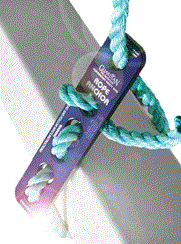
Product Review: The Hold Me Lifeline Anchor Device
The important part of falling down is getting up again. Better yet, make sure you don't fall in the first place.
Those who work or play at any distance above the ground need to be certain that one false step won't be their last. It's why safety harnesses and special climbing equipment exist. In fact, a person is often only as safe as the strength of the lifeline that supports him.
ANSi is Antsy Over Knots
Although not everyone is aware of it, knots have no place in anyone's lifeline. According to the National Cordage Institute, the use of a knot to secure a safety rope can weaken its strength by as much as 50 percent. In fact, ANSi Z-359.1 strictly inveighs against it. So, how else can you secure your lifeline? The answer is simple: The Hold Me Anchor Lifeline Device can provide a safe connection point with no knots required. Its 5,000-pound capacity puts it well above the general recommendation.
What Is an Anchor Lifeline?
An anchor lifeline device serves as a knot-free means of integrating a vertical lifeline system with an anchorage connector. Its use will permit supporting heavy loads in the air with no danger of disentanglement.
The Hold Me Anchor Lifeline device contains five closely-spaced holes topped by a sixth. Its use entails threading the rope or lanyard tightly through the first four in running-stitch fashion, then pulling it securely through a loop left over after passing it through the fifth. The sixth hole will receive either a carabiner or the free end of the lanyard following its attachment to an anchor point.
How Not to Use the Hold Me Rope Anchor
Improper use will negate the safety properties of any anchor device. Never, under any circumstances, attach your lifeline to:
- A metal chimney
- A roof hatch or vent
- A television antenna
- A balcony or staircase railing
- A small duct or pipe
- A stationary ladder
No Bottom-Out; No Swing
Always measure carefully to ensure that the rope will reach its greatest length before a falling person or object hits an obstruction. In addition, it's vital to maintain a perpendicular direction between the edge of the lifeline and its anchor to prevent a deadly pendulum effect.
Where distance from the ground is concerned, there can be no skimping on safety. A simple device like the Hold Me Rope Anchor lifeline device is an easy way to meet with ANSi standards while preserving lives in the process.
Monday, June 23, 2014
Prevent Construction Deaths by Following OSHA’s Fall Safety Standards
Do you know what the number one cause of deaths in the construction industry is? It probably won’t come as a surprise that it’s falling. According to OSHA, in 2012 – the time of the last census taken – there were 806 on-the-job deaths in construction, 35% of which were the result of falls. Most falls directly violated OSHA’s fall protection standards. The good news is, prevention is often as simple as learning these standards and adhering to them diligently, using the proper equipment and best practices. Here are just a few to get you started:
- Duty to Have Fall Protection – This rule stipulates that anyone working on an unprotected edge needs to take the proper precautions by using a fall protection system like safety nets or a personal fall arrest system. Guardrails can also be used.
- Use the Proper Fall Equipment for Its Stipulated Height – If a worker is at six feet or higher, they must have a fall arrest system. It may not sound like much, but workers who are six feet or more above lower levels are at risk for serious injury or death should they fall. Having the proper equipment doesn’t just mean fall arrest systems; it also includes the right kinds of ladders, scaffolds, and safety gear for various heights.
- Fall Protection Systems Must Comply With OSHA Standards – OSHA has a specific set of standards related to the efficacy of fall protection systems. These standards range from guardrail height to the amount of weight that screen or mesh should be able to sustain. There’s also a rigorous set of standards related to dee-rings and snaphooks, wires and cables, and horizontal lifelines. All of HarnessLands’s fall arrest systems and fall protection kits comply with OSHA standards.
- Every Employee Must Undergo a Safety Training Program – Safety training programs are a must for getting employees up to speed on safety hazards, precautions to take, and the proper use of equipment. Any change in a fall protection system will require a new training to update employees on how to use the new equipment. A good training will also include the proper use of rescue systems and first aid kits.
- Prior to Beginning Work, Test Fall Protection Systems and Retractable Lifelines – Before doing anything, it is important to test the gear that you’ll be working with. Testing methods generally involve using weights of the same size and girth of a person, but many people also choose to test much heavier loads. Everything from hooks to self-retracting lifelines must be tested. It may all seem a bit daunting, but complying with OSHA safety standards is an absolute must for anyone in the construction industry. And Harnessland can make it even easier by supplying you with all the right equipment, which complies 100% with OSHA. Don’t take safety for granted!
Tuesday, June 3, 2014
A Review of the Guardian Cyclone Construction Harness
When a construction worker tackles a job around large wind turbines, the level of fall safety needs to be taken up a notch. As they climb the precarious heights to maintain and repair these turbines, construction crews can stay safe and get the protection they need by wearing the Guardian Cyclone construction harness while they work.
The Cyclone features an innovative design that is conducive to the work these specialists carry out each day. Its shoulder adjustment capabilities let workers wear it comfortably without experiencing physical distress, and it features a rope access application failsafe should a rescue be needed.
Keeping the harness untangled also proves to be important while these workers get the job done. With its tangle-free design, the Guardian Cyclone allows workers to ascend ladders in the turbine and focus on their work without fearing that their harness components will get tangled together. Its unique X-back offers perfectly allocated pressure across the shoulders to prevent strain and drive home that tangle-free design.
The Guardian Cyclone provides quick fall-arresting capabilities with its adjustable textile chest attachment loops and dorsal D-ring. In fact, the harness also includes two lateral D-rings, adjustable straps in the chest, leg, and shoulder areas. Workers can keep their tools handy with the tool loops on the back. They can also sit while they work with the harness’ sit-strap extender.
Workers obviously don’t come in one size. The harness is available in sizes small through large to cater to anyone in your crew. Working a job in low visibility? The Cyclone’s bright yellow color will keep you and your crew spotted throughout the job.
Grab the Guardian Cyclone construction harness for you and the rest of your crew at Harness Land. Our competitive sales pricing and free shipping make this one a steal for any construction team.
Monday, June 2, 2014
Calculating Your Fall Distance
When it comes to fall protection at a construction site, having the proper distance measured out can not only limit the impact of a fall but also limit the possibility of injury during that fall. Let’s review the proper calculations you’ll need to take when using both shock absorbing lanyards as well as retractable lifelines. We’ll use average numbers as an example.
Fall Distance Calculation with Shock Absorbing Lanyard & D-Ring Connector
One of the most commonly used shock absorbing lanyards is the six foot variety. Let’s give that a whirl in this example. The lanyard is 6 ft. long, and the max elongation of the absorber during deceleration would be 3.5 ft. An average construction worker is about 6 ft. tall. Let’s add all of those together.
To properly calculate our fall distance, we should add human or product error into the equation. Let’s assume the worker is taller than 6 ft., the harness wasn’t properly fitted, or you miscalculated your distance somewhere else in the equation. Add 3 ft. as a precaution. That leaves us with our suggested safe fall clearance distance of 18.5 ft.
6 + 3.5 + 6 + 3 = 18.5 ft.
It’s worth noting that you’ll need to add the length of any anchorage connectors or D-rings you happen to use to this equation to get a better calculation of your clearance distance.
Fall Distance Calculation with Retractable Lifeline
What would a suggested fall clearance distance be for a retractable lifeline? A few different factors come into play with this one. Again, let’s consider the worker is of average height for this example.
You’ll need to combine the maximum free fall distance of your lifeline with the max deceleration distance. Most models will have those distances measured out to be 2 ft. and 3.5 ft., respectively. We’ll stick with that for this scenario.
Like last time, let’s toss in a buffer zone to account for human error or a too-tall worker. Tack on 3 ft. to your calculation. That leaves us with a suggested safe fall clearance distance of 14.5 ft.
2 + 3.5 + 6 + 3 = 14.5 ft.
Just like in the first example, you’ll need to take the length of any added anchorage connectors or D-rings to get a proper calculation for your fall clearance distance.
Don’t cut corners when it comes to protecting yourself and your workers! Plan accordingly, make sure there is clearance space for a potential fall, and calculate fall distances appropriately. Need a short hand version of this? Check out the graphic on our site.
Friday, May 2, 2014
SRLs with a Leading Edge
Fall protection when working on a site that involves open edges and roofs is extremely important, and it requires a different type of SRL. The retract needs to be designed to minimize the impact on itself when a fall occurs going over a ledge, and it needs to be able to be easily positioned either overhead, at foot level, or at the level of the leading edge. Enter the leading edge SRL.
Among the many features of a leading edge SRL is their integrated shock-absorbing pack that helps limit the impact of a fall’s force on the cabling that is in contact with the ledge itself. This removes unwanted strain and keeps the self-retract strong across every inch of its construction. This is where versatility of attachment really comes in handy. A design that allows overhead, foot level, or leading edge placement allows you to cater your attachments to the work environment without worrying about stress on the cable housing. The Guardian Heavy Duty Edge does just that.
Leading edge SRLs like the Guardian Heavy Duty Edge Series SRL pictured at right are designed to be compact and lightweight without sacrificing strength, stopping power or comfort. In fact, leading edge SRLs like this one will keep arresting forces below 900lbs and has a swivel top to prevent tangling. Their shock packs spring into action when a cable comes in contact with an edge and will arrest the forces of any fall. These built-in shock packs give you that attachment versatility we’ve been talking about. Other brands and models will require overhead attachments only. Not so with Guardian.
Meeting or exceeding all OSHA and ANSI standards, leading edge SRLs are top of the line and the future of edgework safety. Perfect for roofing jobs and high-rise buildings, leading edge SRLs are a must-have. See for yourself why so many construction firms have turned to leading edge SRLs for their ledge jobs, and give the Guardian Heavy Duty Edge series a go when you’re shopping with Harness Land.
Wednesday, April 30, 2014
A Review of the ExoFit NEX Construction Harness
Finding a construction harness that stands up to the demands of a long shift and keeps you comfortable and safe can be a challenge. The NEX construction harnesses for ExoFit is up to the job. Let’s review some of its features so you can see why selecting the NEX from ExoFit as your new construction harness is a no-brainer.
Made for comfort, convenience and customization, the ExoFit NEX is the perfect choice for any job that requires fall protection and any size worker. Some features of the ExoFit NEX include:
The ExoFit brings some new technology to the harness game. Revolver vertical torso adjusters make the harness a gem for workers, regardless of physical build. Tech Lite aluminum D-rings are strong and durable enough to handle the heaviest of loads in the event of a fall. Repel webbing and suspension trauma straps give this harness an unparalleled level of adjustability, comfort and security. In fact, the ExoFit comes with a 30-day comfort guarantee.
Last, but not least, the Duo-Lok Quick Connect buckles make getting in and out of the harness a snap. The Duo-Lok patented design removes any slippage or loosening of the harness webbing – something other quick connects have been known to do. If you’ve thought twice about purchasing a harness with quick connects, the issue has been solved with the ExoFit NEX Duo-Lok System.
Take a look at the ExoFit NEX and see why it’s become such a popular choice for workers looking for added function and comfort to their fall protection gear. Then, do yourself a favor and grab one today.
Made for comfort, convenience and customization, the ExoFit NEX is the perfect choice for any job that requires fall protection and any size worker. Some features of the ExoFit NEX include:
- Built-in padding on shoulders, hips and legs to prevent slips
- Breathable fabric lining for moisture control
- Removable belt for connecting tools
- Well-placed hook connections on back to prevent tangles
- Rip-stitch indicators to quickly inspect a harness involved in a fall
The ExoFit brings some new technology to the harness game. Revolver vertical torso adjusters make the harness a gem for workers, regardless of physical build. Tech Lite aluminum D-rings are strong and durable enough to handle the heaviest of loads in the event of a fall. Repel webbing and suspension trauma straps give this harness an unparalleled level of adjustability, comfort and security. In fact, the ExoFit comes with a 30-day comfort guarantee.
Last, but not least, the Duo-Lok Quick Connect buckles make getting in and out of the harness a snap. The Duo-Lok patented design removes any slippage or loosening of the harness webbing – something other quick connects have been known to do. If you’ve thought twice about purchasing a harness with quick connects, the issue has been solved with the ExoFit NEX Duo-Lok System.
Take a look at the ExoFit NEX and see why it’s become such a popular choice for workers looking for added function and comfort to their fall protection gear. Then, do yourself a favor and grab one today.
Thursday, March 27, 2014
The New Class A Retracts
New to the fall safety equipment industry are Class A retractable lifelines. Class A retracts meet the newest ANSI Z359.14 standards, meaning these retracts are top-of-the-line and will keep you and your construction site ahead of the curve when it comes to safety protocol.You might be wondering what changes came about with ANSI Z359.14. These new standards have increased the test weight for dynamic performance and require that all retractable lifelines be classified as either Class A or Class B based on their performance tests. More specifically, the weight requirement for testing has increased from 220lbs to 282lbs, +/- 2lbs. To be classified as Class A, the arrest distance can’t exceed 24” and the force can’t exceed 1,350lbs with a max peak of 1,800lbs. When environmental conditions (hot, cold or wet) are taken into account, the force can’t exceed 1,575lbs with an identical peak of 1,800lbs.
Fall Safe USA is currently the only manufacturer that develops Class A web retracts at 11’ in length and shorter. Pictured to the right is their 7’ variety with an aluminum housing and 1” Dynema webbing. The snap hook features a double locking swivel with a 3,600lbs gate rating and a steel carabiner.
All Class A retracts from Fall Safe USA feature a hook rating of 5,000lbs and a max working load of 310lbs. They also meet the OSHA 1926-502 standard as well as ANSI Z359.14-2012 and A10.32 2004 standards. Available in single and double web retracts, these Class A retractable lifelines from Fall Safe USA are a smart choice for any construction team that wants an upgrade to their fall arrest devices.
Subscribe to:
Posts (Atom)

